
GM LS3 Engine Problems and Long-Term Reliability
The GM LS3 engine is often hailed as the pinnacle of GM’s naturally aspirated V8 engineering—a powerplant that balanced brute strength, daily drivability, and legendary LS-series durability. Found under the hood of Corvette C6s, Camaro SSs, and countless hot rod swap projects, it’s earned a reputation as a “set-it-and-forget-it” engine for enthusiasts and casual drivers alike. But here’s the reality: even the most revered LS engines aren’t immune to wear, failure, and costly repairs—especially as they rack up miles or face aggressive driving.
If you’re considering buying a vehicle with an LS3, planning a crate engine swap, or weighing whether to rebuild your existing LS3, you need more than just fanboy hype—you need real-world data on its weaknesses, reliability limits, repair costs, and lifespan. This guide cuts through the noise to deliver actionable insights: the most common LS3 problems, how long the engine truly lasts, how it stacks up against other LS and modern LT engines, and when repair, rebuild, or replacement is the smart financial move. Plus, we’ll show you how Wanasign Auto’s OEM-quality parts can keep your LS3 running strong for years.
Overview of the GM LS3 Engine
To understand the LS3’s strengths and weaknesses, we first need to ground ourselves in its history and design. The LS3 wasn’t a revolutionary leap—it was a refined evolution of GM’s LS architecture, built to deliver more power while retaining the series’ core reliability.
LS3 Engine Background
Introduced in 2008, the LS3 was GM’s response to demand for more power from its naturally aspirated V8s, replacing the LS2 in high-performance models. It built on the LS2’s solid foundation with key upgrades: larger displacement (6.2L vs. the LS2’s 6.0L), rectangular-port cylinder heads for better airflow, and improved camshaft design. These changes made it one of the most powerful naturally aspirated V8s GM had ever produced for a production vehicle—earning it a spot in the Corvette C6, Camaro SS, and later as a popular crate engine for custom builds.
What made the LS3 stand out? It combined race-bred performance (430+ hp) with the LS series’ signature simplicity: an overhead valve (OHV) design, aluminum block for light weight, and port fuel injection (EFI) for consistent delivery. For enthusiasts, this meant a powerplant that was easy to work on, affordable to modify, and capable of handling daily driving or track days without breaking a sweat. It’s no wonder the LS3 is still a top choice for crate engine swaps in hot rods, trucks, and even classic muscle cars.
LS3 Key Specifications
The LS3’s specs highlight its balance of power and durability. Here’s a detailed breakdown of its core components:
| Spec | Detail |
|---|---|
| Displacement | 6.2L (376 cubic inches) |
| Configuration | OHV (Overhead Valve) V8, 2 valves per cylinder |
| Block Material | Aluminum (cast, with nodular iron main caps for strength) |
| Cylinder Heads | Aluminum rectangular-port (LS3/L92 heads, 68cc combustion chambers) |
| Compression Ratio | 10.7:1 |
| Horsepower (HP) | 430–480 hp (varies by application: 430 hp in Corvette C6, 426 hp in Camaro SS, 480 hp in Corvette Grand Sport) |
| Torque | 424–470 lb-ft (matches HP variations) |
| Fuel System | Sequential port fuel injection (EFI) |
| Ignition System | Coil-on-plug |
| Camshaft | Hydraulic roller (stock lift: 0.525” intake / 0.525” exhaust) |
Vehicles Using the LS3
The LS3 was never a “one-size-fits-all” engine—GM reserved it for its highest-performance production vehicles, then made it available as a crate engine for custom builds. Here are the most common applications:
- Chevrolet Corvette C6 (2008–2013): The LS3 was the base engine for the Corvette C6 from 2008 to 2013, replacing the LS2. It produced 430 hp (436 hp with the optional dual-mode exhaust) and was paired with either a 6-speed manual or automatic transmission.
- Chevrolet Camaro SS (2010–2015): When the Camaro returned for the 2010 model year, the LS3 was the heart of the SS trim, delivering 426 hp and 420 lb-ft of torque. It was a key selling point for enthusiasts seeking muscle car performance.
- Chevrolet Corvette Grand Sport (2010–2013): The Grand Sport variant of the C6 used a high-output LS3, cranking out 430 hp (436 hp with dual-mode exhaust) and featuring performance upgrades like a dry-sump oil system.
- Crate Engine Swaps: GM’s LS3 crate engine (Part No. 19370448) became a staple for hot rod, muscle car, and truck builds. Its compact size, affordability, and power made it ideal for swapping into classic vehicles (e.g., 1960s Camaros, 1970s Chevelles) and modern trucks seeking more performance.
Common GM LS3 Engine Problems
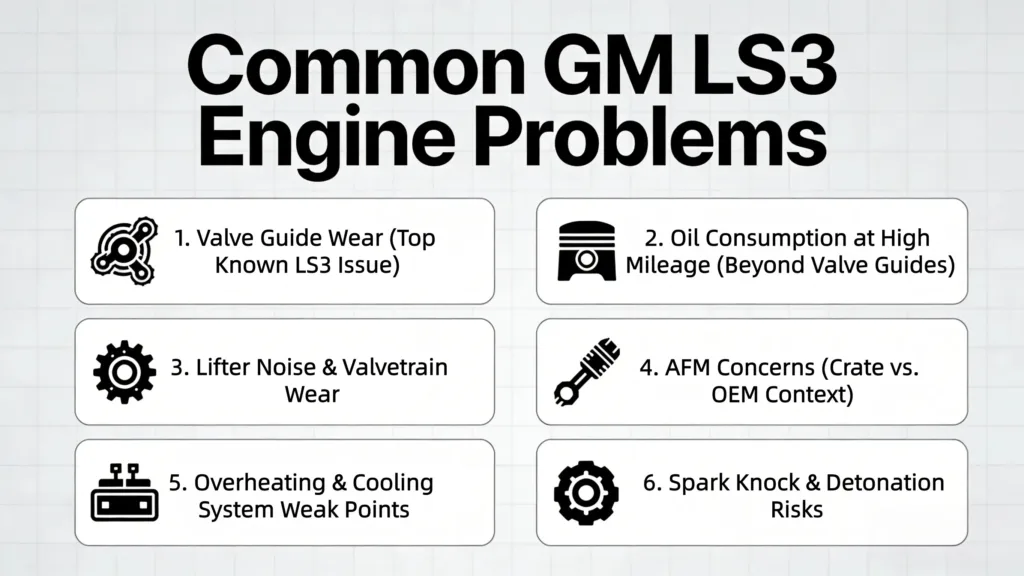
Make no mistake: the LS3 is a reliable engine. But it’s not perfect. Over years of real-world use, owners and mechanics have identified recurring issues—most of which are tied to wear, heat, or poor maintenance. Below are the most common LS3 problems, sorted by frequency and severity.
1. Valve Guide Wear (Top Known LS3 Issue)
Valve guide wear is the single most reported problem with the LS3 engine—and it’s not a minor issue. The LS3’s rectangular-port cylinder heads (LS3/L92) use thin-walled valve guides that are prone to wear over time, especially in high-mileage or aggressively driven engines.
Root Cause: The LS3’s valve guides are made from a powdered metal alloy that’s lighter but less durable than the guides used in older LS engines (e.g., LS1, LS2). Combine this with the engine’s high compression (10.7:1), elevated operating temperatures (especially in track use), and aggressive valve timing, and the guides gradually wear down. This creates excessive clearance between the valve stem and guide.
Symptoms: The first sign of valve guide wear is excessive oil consumption (burning 1+ quart of oil every 1,000–2,000 miles). You’ll also notice blue smoke from the exhaust—especially during cold starts, acceleration, or high RPM. In severe cases, the wear can cause valve ticking (from loose valve stems) or even misfires (if oil fouls the spark plugs). Some owners also report a “hissing” sound from the engine bay as air leaks around the worn guides.
When It Appears: Most LS3s start showing valve guide wear between 80,000–120,000 miles. However, this can happen earlier (50,000–70,000 miles) if the engine is used for track days, frequent high-RPM driving, or if low-quality oil is used.
Repair Options & Costs: Fixing valve guide wear requires cylinder head work—there’s no quick “band-aid” solution. The two main options are:
- Valve Guide Replacement: Mechanics remove the cylinder heads, press out the worn guides, and install new, more durable guides (e.g., bronze guides, which are thicker and more heat-resistant than stock). This also requires re-cutting the valve seats and lapping the valves. Cost: $2,500–$4,500 (parts + labor) for both heads.
- Cylinder Head Replacement: For severe wear (or if the heads are cracked), replacing the cylinder heads with new or remanufactured units is a better option. Wanasign’s OEM-quality LS3 cylinder heads come pre-assembled with upgraded guides, saving time and ensuring reliability. Cost: $3,000–$5,500 (parts + labor) for a complete head replacement.
Wanasign Recommendation: Skip the costly guide replacement and upgrade to our LS3 Cylinder Head Assemblies. Our heads feature upgraded bronze valve guides, hardened valve seats, and are 100% tested for fit and performance—perfect for resolving valve guide wear and preventing future issues.
2. Oil Consumption at High Mileage (Beyond Valve Guides)
Even without valve guide wear, LS3s are prone to increased oil consumption as they hit high mileage (100,000+ miles). This is often confused with valve guide issues, but it has separate root causes.
Root Cause: The two main culprits are piston ring wear andPCV system failure. Over time, the LS3’s piston rings (especially the oil control rings) wear down, allowing oil to seep into the combustion chamber. A clogged or faulty PCV (Positive Crankcase Ventilation) valve exacerbates the issue by increasing crankcase pressure, which pushes more oil past the rings. Aggressive driving (frequent high RPM) and short trips (where the engine never fully warms up) accelerate ring wear.
Normal vs. Excessive Oil Usage: GM considers 1 quart of oil consumed every 2,000 miles “normal” for high-performance engines like the LS3. Anything more than that is excessive. To distinguish between ring wear and valve guide wear: valve guide wear causes smoke during cold starts, while ring wear causes smoke during acceleration and high RPM (when cylinder pressure is highest).
Diagnosis Checklist: To confirm the cause of oil consumption:
- Replace the PCV valve first (cost: $20–$50). If oil consumption drops, the PCV system was the issue.
- Perform a compression test. Low compression in one or more cylinders points to piston ring wear.
- Do a leak-down test. Excessive leakage (more than 10%) indicates worn rings or valve seats.
- Inspect the spark plugs. Oil-fouled plugs (wet, black deposits) confirm oil is entering the combustion chamber.
Repair Costs: Fixing piston ring wear requires a top-end rebuild (replacing rings, valve seals, and PCV system): $1,500–$3,000 (parts + labor). For severe wear, a full engine rebuild may be necessary: $4,000–$6,500.
3. Lifter Noise & Valvetrain Wear
Lifter noise (ticking) is a common issue in LS3 engines—especially in cold weather or high-mileage units. While it’s often harmless at first, ignoring it can lead to camshaft damage.
Root Cause: The LS3 uses hydraulic roller lifters that rely on oil pressure to maintain proper valve lash. Over time, the lifters can wear down (from high RPM or poor oil quality) or become clogged with sludge (from infrequent oil changes). This causes the lifters to “bleed down” (lose pressure), resulting in a ticking noise as the valve slams against the lifter.
Symptoms: The most obvious sign is a ticking noise from the top of the engine—worse when cold, and often fading as the engine warms up (as oil pressure builds). In severe cases, the ticking persists at all temperatures, and you may notice reduced power (from incomplete valve opening) or misfires. If the lifter fails completely, it can cause camshaft lobe wear (a far more costly repair).
When It Appears: Lifter noise typically starts between 60,000–100,000 miles. It’s more common in engines that use conventional oil (instead of synthetic) or have extended oil change intervals (10,000+ miles).
Repair Options & Costs:
- Minor Case: Flush the oil system with a sludge-dissolving additive (cost: $30–$60) and switch to full-synthetic oil (5W-30, GM Dexos 1 approved). Replace the oil filter with a high-quality unit (Wanasign or AC Delco). This resolves the issue for 30% of owners.
- Severe Case: Replace the lifters (and often the pushrods and rocker arms, since worn lifters can damage them). For the LS3, this requires removing the intake manifold and valve covers. Cost: $2,000–$4,000 (parts + labor) for a complete valvetrain refresh.
Wanasign Recommendation: Use our LS3 Hydraulic Roller Lifters and Pushrods for a durable fix. Our lifters are OEM-spec and tested to handle high RPM, making them ideal for both daily drivers and track cars.
4. AFM Concerns (Crate vs. OEM Context)
First, a critical clarification: factory LS3 engines do NOT have Active Fuel Management (AFM). AFM (GM’s cylinder deactivation system) was used in other LS engines (e.g., LS4, L99) but not the LS3. However, crate engine buyers and swap enthusiasts often confuse the LS3 with AFM-equipped engines—and some LS3 swaps use AFM components by mistake, leading to lifter failures.
Root Cause: The confusion arises because the LS3’s block is similar to AFM-equipped blocks (e.g., L99). If a swap uses an AFM camshaft, lifters, or valley cover with an LS3 block, the AFM lifters can fail. AFM lifters are more complex (with solenoids) and less durable than the LS3’s standard lifters—especially in high-performance applications.
Symptoms: AFM-related lifter failure causes the same ticking noise as standard lifter wear, but it often happens earlier (20,000–50,000 miles). You may also notice rough idle, reduced power, or a check engine light with codes P052E (AFM lifter performance) or P0300 (random misfire).
Prevention: For LS3 crate engine swaps, avoid using AFM components. Stick to LS3-specific camshafts, lifters, and valley covers. If you’re buying a used LS3-powered vehicle, confirm it’s a true LS3 (not an L99 with AFM) by checking the VIN or engine code (LS3 code: “L99” is the AFM version of the Camaro SS engine).
5. Overheating & Cooling System Weak Points
The LS3 runs hot—especially in track use or vehicles with poor cooling system maintenance. While the factory cooling system is adequate for daily driving, it has weak points that can lead to overheating.
Root Cause: The LS3’s factory radiator (especially in Camaro SS and early Corvette C6 models) is undersized for track use. Additionally, the factory thermostat (195°F) can stick closed, restricting coolant flow. Over time, the radiator becomes clogged with debris, and the water pump impeller wears down—reducing cooling efficiency. For crate engine swaps, improper radiator sizing (too small) or fan setup (insufficient airflow) exacerbates the issue.
Symptoms: Overheating under load (e.g., track days, towing, climbing hills) is the most common sign. The temperature gauge will spike into the “hot” zone, and you may notice coolant leaks (from hoses or the radiator) or steam from the engine bay. In severe cases, overheating can cause head gasket failure or warped cylinder heads.
Repair & Upgrade Options:
- Daily Drivers: Replace the thermostat (cost: $50–$100) and flush the cooling system (cost: $150–$300) every 30,000–50,000 miles. Inspect hoses for cracks and replace as needed.
- Track Cars/Swaps: Upgrade to a larger aluminum radiator (e.g., 3-row vs. factory 2-row) and a high-flow water pump. Add an electric fan upgrade for better airflow at low speeds. Cost: $800–$1,500 (parts + labor) for a complete cooling system upgrade.
Wanasign Recommendation: Our LS3 High-Flow Radiators and Water Pumps are designed for high-performance use. They provide 30% more cooling capacity than factory parts, making them perfect for track days and swaps.
6. Spark Knock & Detonation Risks
The LS3’s high compression (10.7:1) makes it sensitive to fuel quality and timing—leading to spark knock (detonation) if not properly maintained.
Root Cause: Detonation occurs when the air-fuel mixture ignites prematurely (before the spark plug fires). For the LS3, this is often caused by: 1) using low-octane fuel (below 91 octane, which is required for the LS3), 2) carbon buildup in the combustion chambers (which increases compression), 3) faulty knock sensors, or 4) advanced ignition timing (from a modified tune).
Symptoms: Spark knock sounds like a metallic pinging or knocking noise during acceleration or high load (e.g., towing, climbing hills). It’s most noticeable when using low-octane fuel. If left unaddressed, detonation can damage pistons, rods, and the crankshaft—leading to catastrophic engine failure.
Prevention & Fixes:
- Always use 91+ octane gasoline (top-tier detergent fuel is best).
- Clean the combustion chambers and intake valves every 30,000–50,000 miles to remove carbon buildup (cost: $200–$400).
- Replace faulty knock sensors (common in high-mileage LS3s) to ensure the engine’s ECU can adjust timing to prevent detonation. Cost: $300–$600 (parts + labor).
- If you’ve modified the engine (e.g., cam swap, intake upgrade), get a custom tune to adjust timing and fuel delivery.
LS3 Engine Reliability: How Long Does It Really Last?
The LS3’s reputation for reliability is well-earned—but its lifespan depends on how it’s driven and maintained. Below is a realistic breakdown of its expected longevity, how it stacks up against other LS engines, and how it compares to modern LT engines.
Expected Lifespan (Stock)
A stock LS3 engine, when properly maintained, will last 200,000–300,000 miles. Many owners report hitting 250,000 miles with only minor repairs (e.g., lifters, water pump). Some even reach 300,000+ miles with careful maintenance and no track use.
Conditions That Shorten Lifespan:
- Aggressive Driving/Track Use: Frequent high RPM, hard acceleration, and track days increase wear on valve guides, lifters, and bearings. Track-driven LS3s often last 150,000–200,000 miles.
- Poor Maintenance: Skipped oil changes, using conventional oil (instead of synthetic), and neglecting the cooling system are the biggest killers. LS3s with poor maintenance histories often fail before 100,000 miles.
- Low-Octane Fuel: Consistent use of 87 or 89 octane fuel leads to detonation, which damages internals over time.
- Crate Engine Swaps with Poor Installation: Improper wiring, cooling system setup, or exhaust leaks can shorten the engine’s life.
Real Owner Case Examples:
- A 2010 Camaro SS owner reported 280,000 miles with only routine maintenance (oil changes, spark plugs, water pump) and one lifter replacement at 220,000 miles.
- A 2012 Corvette C6 owner with 240,000 miles noted valve guide wear at 180,000 miles (replaced guides with bronze units) and continued driving without issues.
- A crate engine swap in a 1967 Camaro reached 150,000 miles with track use, requiring a valve guide and lifter replacement at 120,000 miles.
LS3 vs. Other LS Engines (Reliability Comparison)
The LS3 is often ranked among the most reliable LS engines—but how does it compare to its siblings? Below is a reliability score (★/5) and key issues for the most common LS variants:
| Engine | Reliability Score (★/5) | Known Issues | Lifespan (Miles) |
|---|---|---|---|
| LS3 (6.2L) | ★★★★½ | Valve guide wear, oil consumption, lifter noise | 200,000–300,000 |
| LS2 (6.0L) | ★★★★ | Intake manifold gasket failure, lower power than LS3 | 180,000–250,000 |
| LS7 (7.0L) | ★★★ | Valve spring failure (common in track use), high maintenance costs | 150,000–200,000 |
| LS1 (5.7L) | ★★★★ | OptiSpark failure (in F-body models), oil leaks | 180,000–250,000 |
| L99 (6.2L AFM) | ★★★½ | AFM lifter failure, oil consumption | 150,000–220,000 |
Key Takeaway: The LS3 outperforms the LS7 (more reliable) and matches the LS2/LS1 (more power) in reliability. Its only major weakness—valve guide wear—is fixable with upgraded parts, making it a better long-term choice than the LS7 for daily drivers.
Is the LS3 Better Than Modern LT Engines?
GM’s modern LT engines (e.g., LT1, LT4) replaced the LS series in 2014, offering direct injection (DI), variable valve timing, and better fuel efficiency. But does that make them more reliable than the LS3?
LS3 vs. LT1: Reliability Trade-Offs:
- Complexity: The LS3’s port injection is simpler and more reliable than the LT1’s direct injection. DI systems are prone to carbon buildup on intake valves (since fuel no longer cleans the valves), requiring expensive cleaning every 30,000–50,000 miles. The LS3’s port injection avoids this issue.
- Maintenance Costs: The LS3’s parts are cheaper and more widely available than the LT1’s. For example, an LS3 cylinder head replacement costs $3,000–$5,500, while an LT1 head replacement costs $4,500–$7,000.
- Fuel Efficiency: The LT1 is more fuel-efficient (16–22 MPG vs. 14–20 MPG for the LS3), but this comes at the cost of increased complexity.
- Power: The LT1 (455 hp) is more powerful than the LS3 (430 hp), but the LS3 is easier to modify (e.g., cam swap, intake upgrade) for more power.
Conclusion: For reliability and ease of maintenance, the LS3 is better than modern LT engines—especially for DIY mechanics and enthusiasts. The LT engines offer better fuel efficiency and power, but their complexity and higher maintenance costs make the LS3 a better long-term choice for those prioritizing durability.
Repair vs. Rebuild vs. Replacement
When your LS3 develops issues, you’re faced with three options: repair the specific problem, rebuild the engine, or replace it with a long block. Below is a cost breakdown to help you make the smart financial decision.
Typical Repair Costs
For isolated issues (e.g., valve guides, lifters), targeted repairs are the cheapest option. Here are the average costs for common LS3 repairs (U.S. market):
| Repair | Cost Range (Parts + Labor) |
|---|---|
| Valve Guide Replacement (both heads) | $2,500–$4,500 |
| Cylinder Head Replacement (both heads) | $3,000–$5,500 |
| Lifter & Camshaft Replacement | $2,000–$4,000 |
| Oil Control Fixes (Piston Rings + PCV) | $1,500–$3,000 |
| Cooling System Upgrade (Radiator + Water Pump + Fan) | $800–$1,500 |
| Knock Sensor Replacement | $300–$600 |
Rebuilding an LS3
Rebuilding an LS3 makes sense if the engine has multiple issues (e.g., valve guide wear + piston ring wear) or if you want to upgrade performance. A rebuild involves replacing all worn internals (pistons, rings, bearings, valves, guides) and machining the block/heads for proper fit.
When Rebuild Makes Sense:
- Engine has 150,000+ miles with multiple failures (valve guides + lifters + oil consumption).
- You want to upgrade performance (e.g., higher compression, aggressive camshaft) while fixing reliability issues.
- The engine block is in good condition (no cracks, minimal wear).
What Should Be Replaced in a Rebuild:
- Pistons and piston rings (upgraded to forged for performance).
- Main bearings and rod bearings.
- Valves, valve guides (bronze), and valve seals.
- Camshaft and lifters (upgraded to high-performance units if desired).
- Timing chain and tensioner.
- Gaskets and seals (complete engine gasket set).
Cost of Rebuilding: $4,000–$7,500 (parts + labor). Performance upgrades (e.g., forged pistons, custom cam) can push costs to $8,000–$12,000.
Long Block Replacement Option
For many LS3 owners, replacing the engine with a long block is the smartest choice. A long block includes a fully assembled block, cylinder heads, camshaft, lifters, and timing components—ready to drop into your vehicle.
Why Long Block Is Safer:
- Reliability: Wanasign’s LS3 long blocks are 100% tested and built with OEM-quality parts, eliminating the risk of mismatched or faulty components (a common issue with rebuilds).
- Time Savings: A long block replacement takes 8–12 hours (vs. 20–30 hours for a rebuild), getting your vehicle back on the road faster.
- Warranty: Wanasign’s long blocks come with a 3-year/100,000-mile warranty—something most rebuilds don’t offer.
- Cost-Effective: A long block costs $5,000–$8,000 (parts + labor), which is comparable to a high-quality rebuild but offers better reliability and a warranty.
Wanasign Recommendation: If your LS3 has multiple issues or high mileage, skip the rebuild and choose our LS3 Long Block Engine Assemblies. Our long blocks are built to OEM specs, tested for performance, and backed by an industry-leading warranty—perfect for daily drivers and track cars alike.
Preventive Maintenance to Maximize LS3 Longevity
The best way to avoid LS3 problems is to prioritize preventive maintenance. Below are the critical tasks to keep your LS3 running strong for 200,000+ miles.
1. Oil & Lubrication Strategy
Oil is the lifeblood of the LS3—use the right oil and change it on time.
- Oil Type: Use 5W-30 full-synthetic oil that meets GM Dexos 1 specifications. Avoid conventional oil—synthetic oil resists breakdown at high temperatures and provides better protection for valvetrain components. Wanasign’s synthetic oil is formulated for high-performance V8s like the LS3.
- Change Intervals:
- Daily drivers: Every 5,000 miles or 6 months (whichever comes first).
- Track cars/aggressive driving: Every 3,000–4,000 miles (high RPM and heat break down oil faster).
- Oil Filter: Use a high-quality filter (Wanasign, AC Delco, or Wix) with every oil change. Cheap filters allow debris to circulate, causing premature wear.
2. Cooling System Upgrades & Maintenance
Keep the LS3 cool to avoid valve guide wear and overheating.
- Coolant Flush: Flush and replace coolant every 30,000–50,000 miles. Use GM Dex-Cool coolant (or equivalent) to prevent corrosion.
- Thermostat Replacement: Replace the thermostat every 80,000–100,000 miles (or if it sticks closed). A faulty thermostat is a common cause of overheating.
- Track Car/Swap Upgrades: Install a 3-row aluminum radiator, high-flow water pump, and electric fan upgrade. This ensures the engine stays cool during aggressive driving.
Wanasign Recommendation: Our LS3 Cooling System Kit includes a high-flow radiator, water pump, and thermostat—everything you need to upgrade your cooling system in one box.
3. Spark Plug & Ignition Maintenance
The LS3’s coil-on-plug ignition system is reliable, but spark plugs wear out over time.
- Replace spark plugs every 60,000–100,000 miles. Use OEM-spec iridium plugs (AC Delco 41-110) for better performance and longevity.
- Inspect ignition coils every 50,000 miles for cracks or corrosion. Faulty coils cause misfires and reduce fuel efficiency.
4. Driving Habits That Kill LS3s (Avoid These)
Your driving habits have a bigger impact on LS3 longevity than you think. Avoid these behaviors:
- Short Trips: Frequent short trips (≤10 miles) prevent the engine from reaching operating temperature, leading to moisture buildup and oil dilution. If you only drive short distances, change oil more frequently (every 4,000 miles).
- Low-Octane Fuel: Never use 87 or 89 octane fuel. The LS3’s high compression requires 91+ octane to prevent detonation.
- Ignoring Early Noise: A small tick or knock today can become a $4,000 repair tomorrow. Address valvetrain noise, exhaust leaks, or detonation immediately.
- Overloading/Towing Beyond Capacity: The LS3 is powerful, but towing or hauling beyond your vehicle’s capacity increases engine stress and heat.
Is the LS3 Engine Worth Buying Today?
The LS3 is over a decade old—but it’s still a great choice for many buyers. Below are the best use cases and who should avoid it.
Best Use Cases for the LS3
- Daily Drivers: The LS3’s balance of power and reliability makes it perfect for daily use. It’s fuel-efficient enough for commutes (14–20 MPG) and powerful enough for highway merging and passing.
- Track Cars: The LS3’s naturally aspirated power, durability, and easy modding make it ideal for track days. With cooling system upgrades and valve guide replacements, it can handle aggressive track use.
- Swap Projects: The LS3’s compact size, affordability, and power make it the top choice for swapping into classic cars, trucks, and hot rods. Its simplicity (port injection, OHV design) makes it easy to wire and maintain.
- Enthusiasts Who Want a Reliable V8: If you want a V8 that’s easy to work on, has a large parts market, and won’t leave you stranded, the LS3 is hard to beat.
Who Should Avoid an LS3?
- Budget-Only Buyers: While the LS3 is reliable, repairs (e.g., valve guides, lifters) are costly. If you can’t afford $2,000–$5,000 in potential repairs, consider a more affordable engine (e.g., LS1, LS2).
- Buyers with Poor Maintenance Habits: The LS3 requires regular oil changes and cooling system care. If you skip maintenance, it will fail prematurely.
- Those Seeking the Latest Technology: If you want direct injection, hybrid technology, or the latest driver aids, the LS3 (a 2000s-era engine) won’t meet your needs. Consider a modern LT engine instead.
Frequently Asked Questions
Q1: How reliable is the GM LS3 engine?
A1: The LS3 is very reliable—earning a 4.5/5 rating. A properly maintained stock LS3 lasts 200,000–300,000 miles. Its main weakness is valve guide wear, which is fixable with upgraded parts.
Q2: What is the most common LS3 problem?
A2: Valve guide wear is the most common LS3 issue. It causes excessive oil consumption (1+ quart/1,000 miles) and blue smoke. It typically appears at 80,000–120,000 miles, especially in aggressively driven engines.
Q3: How long does an LS3 engine last?
A3: A stock LS3 lasts 200,000–300,000 miles with proper maintenance. Track-driven or poorly maintained LS3s last 150,000–200,000 miles. Upgrades like bronze valve guides can extend lifespan further.
Q4: Is the LS3 better than the LS7?
A4: For reliability and daily drivability, yes. The LS3 (4.5/5 reliability) is more durable than the LS7 (3/5), which suffers from valve spring failure. The LS7 is more powerful (505 hp) but less reliable and more costly to maintain.
Q5: Can the LS3 handle boost reliably?
A5: Yes—with upgrades. A stock LS3 can handle 4–6 psi of boost safely, but you’ll need to upgrade the fuel system, pistons, and head gaskets for higher boost (8+ psi). Proper tuning is critical to avoid detonation.
Final Verdict: LS3 Reliability Summary
The GM LS3 remains one of the best naturally aspirated V8 engines ever produced. Its combination of power, simplicity, and durability makes it a favorite among enthusiasts and builders alike.
However, long-term ownership requires awareness of known issues—especially valve guide wear and oil consumption. Address problems early, maintain the engine properly, and the LS3 can deliver decades of performance.
For owners facing major repairs, weighing rebuild versus replacement carefully can save both time and money.
A well-maintained LS3 isn’t just powerful—it’s built to last.


