
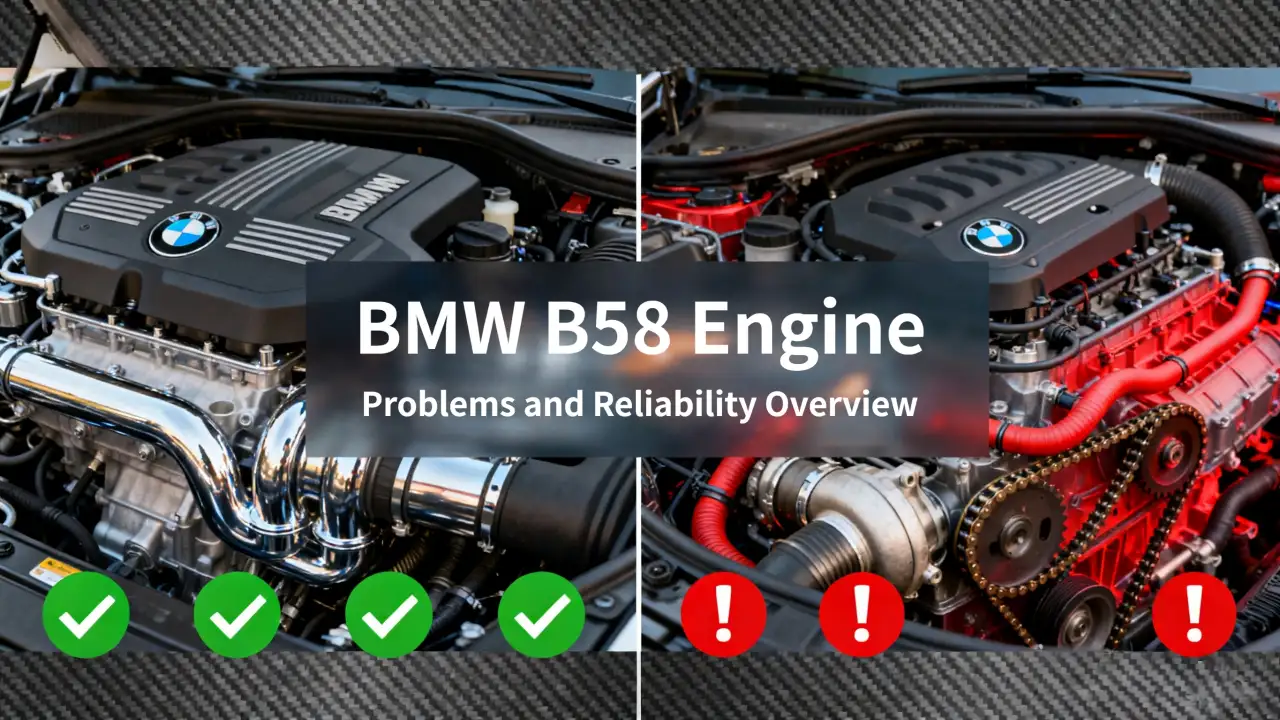
BMW B58 Engine Problems and Reliability Overview
Few modern engines have earned the admiration that the BMW B58 inline-six commands. Introduced in 2015 as part of BMW’s modular “B” engine family, it has powered everything from luxury sedans like the 540i to sports coupes like the M240i and even the Toyota Supra.
The B58 was BMW’s answer to years of criticism about its predecessor, the N55 — improving reliability, cooling, and performance. It’s smooth, efficient, and extremely tunable. In fact, many enthusiasts call it “the best BMW engine in decades.”
But let’s be real: no engine is flawless. Even the mighty B58 develops issues over time — oil leaks, cooling problems, or fuel system wear. The good news? These problems are well-documented, predictable, and often preventable with the right maintenance and replacement parts.
In this Wanasign Auto guide, we’ll take a deep dive into the most common BMW B58 engine problems, explore real-world symptoms, repair costs, and maintenance strategies — and show you how to keep your turbocharged inline-six running smoothly past 200,000 miles.
BMW B58 Engine Overview and Specs
The B58 is a 3.0L turbocharged inline-six engine, part of BMW’s modular engine family (shared with the B48 four-cylinder and B57 diesel). Its design focuses on balance—delivering sports car-level performance while maintaining daily drivability and efficiency. Here’s a deep dive into its key specs and highlights:
Core Technical Specifications
- Displacement: 3.0 liters (2998 cc)
- Configuration: Inline-six (I6), rear-wheel drive/all-wheel drive compatible
- Turbocharger: Single twin-scroll turbo (reduces lag, improves response)
- Fuel System: Direct injection (DI) with high-pressure fuel pump
- Compression Ratio: 11.0:1
- Power Output: 322–382 hp (varies by model/year: 340i = 322 hp, M240i = 382 hp, Toyota Supra = 382 hp)
- Torque: 332–369 lb-ft (available from 1,500–5,200 RPM for linear power delivery)
- Engine Management: BMW’s MSV80 ECU (supports tuning for additional power)
Key Design Improvements Over the N55
- Closed-deck block: Stronger than the N55’s open-deck design, better handling boost and heat
- Forged crankshaft and connecting rods: Improves durability for high-performance use
- Larger intercooler: More efficient heat dissipation, reducing knock risk
- Updated fuel injection: Higher pressure (350 bar vs. N55’s 200 bar) for cleaner combustion
- Integrated exhaust manifold: Improves turbo spool and emissions compliance
Models Equipped with the B58 Engine (2016–2024)
- BMW 340i (G20/G21), 440i (G32/G33), 540i (G30), 640i (G32)
- BMW X3 M40i, X4 M40i, X5 xDrive40i, X6 xDrive40i
- BMW M240i (G42), Z4 M40i (G29)
- Toyota Supra (A90/A91) – Co-developed with BMW, uses a modified B58
- Alpina B3/B4 (based on the B58 with additional tuning)
Enthusiasts often call the B58 “BMW’s best modern inline-six” for its ability to balance daily usability with track-ready performance—all while being more reliable than its turbocharged predecessors (N54, S55).
Common BMW B58 Engine Problems (Deep Dive)
The BMW B58 engine—successor to the N55 — is widely regarded as one of the best modern inline-six engines ever produced. It’s smooth, powerful, and capable of impressive longevity when maintained properly. However, no engine is entirely free of issues. Over the years, several recurring problems have surfaced among high-mileage or heavily tuned B58s.
Below, we’ll explore the most common BMW B58 engine problems, their causes, warning signs, repair costs, and long-term reliability implications — all backed by real-world owner experiences and maintenance insights.

1. Coolant Leaks from the Expansion Tank and Water Pump
Overview:
One of the most reported issues with the B58 engine involves coolant loss caused by cracks in the plastic coolant expansion tank or premature water pump failure. This is a problem that continues BMW’s long-standing trend of cooling system fragility — a known weak point since the M54 and N52 days.
Common Symptoms:
- Low coolant warning light on the dashboard
- Puddles of coolant near the front of the engine
- Slight overheating or fluctuating engine temperatures
- Sweet smell (glycol) from under the hood
Root Cause:
The thermoplastic materials used in the expansion tank and water pump housing degrade under repeated heat cycles. In turbocharged engines like the B58, where under-hood temperatures run high, this aging process accelerates.
Repair Options & Cost:
- Expansion Tank Replacement: $150–$250 parts; $300–$450 total with labor
- Water Pump Replacement: $400–$600 parts; $700–$1,000 total with labor
If you’re replacing one, it’s often wise to replace both the pump and thermostat assembly as a preventive measure — saving labor costs down the line.
Wanasign Tip:
Choose a metal-impeller water pump for better durability, and always use OEM-spec coolant to prevent corrosion buildup. Wanasign’s cooling system category includes direct-fit replacements for BMW 3.0L inline-six applications.
2. Valve Cover and Oil Filter Housing Gasket Leaks
Overview:
Like many BMW engines, the B58 is prone to oil leaks as it ages — particularly from the valve cover gasket and oil filter housing gasket. This is often noticed after 50,000–70,000 miles and is more common in cars subjected to frequent stop-and-go driving or extended oil change intervals.
Symptoms:
- Burning oil smell after driving
- Visible oil seepage around the valve cover area
- Oil spots on the driveway
- Minor smoke from the engine bay under load
Cause:
The rubber-based gaskets lose elasticity over time due to heat exposure. Since BMW uses magnesium valve covers on some B58 variants, even a small warp in the cover can create leak paths.
Repair Cost:
- Valve Cover Gasket: $80–$120 parts; $400–$700 total with labor
- Oil Filter Housing Gasket: $20–$40 parts; $150–$300 total
Pro Tip:
Always check the PCV valve during gasket replacement — a clogged or failed PCV system increases crankcase pressure, worsening oil leaks.
Wanasign Product Match:
See Cylinder Head Assembly for premium gasket and valve cover kits designed for durability under high thermal load.
3. High-Pressure Fuel Pump (HPFP) Wear
Overview:
The B58 features a direct fuel injection system operating at extremely high pressures — up to 5,000 psi. Over time, the high-pressure fuel pump (HPFP) can experience wear, leading to starting issues, misfires, or power loss.
Warning Signs:
- Extended crank before start
- Rough idle or misfire codes (P0171, P0087, etc.)
- Sudden drops in fuel pressure
- Reduced performance under load
Cause:
Fuel contamination, infrequent filter replacement, and ethanol-rich fuels can accelerate HPFP wear. It’s more likely in tuned engines running higher boost levels.
Repair & Cost:
- HPFP Replacement: $450–$700 parts; $800–$1,100 total
Maintenance Tip:
Use Top Tier premium gasoline and replace your fuel filter every 40,000–50,000 miles. For tuned B58s, upgrading to an aftermarket performance HPFP (like those offered by Dorch or Spool) ensures consistent delivery at higher flow rates.
4. Carbon Buildup on Intake Valves (Direct Injection)
Overview:
Because the B58 is a direct-injection engine, fuel does not wash over the intake valves — leading to gradual carbon buildup. While not catastrophic, this buildup can restrict airflow, causing reduced efficiency and occasional misfires.
Symptoms:
- Rough idle or hesitation
- Loss of throttle response
- Check the Engine Light for misfire codes
- Poor fuel economy
When It Happens:
Usually visible after 60,000–80,000 miles, depending on fuel quality and driving habits.
Fix:
The best solution is a walnut blasting procedure — a professional cleaning method that removes carbon deposits without damaging the valves.
Cost:
- Walnut Blasting: $350–$600
DIY Preventive Options:
- Add fuel system cleaner every few thousand miles (like Techron or Liqui Moly Jectron).
- Consider installing an oil catch can to reduce oil vapor buildup from the PCV system.
5. VANOS Solenoid Malfunction
Overview:
BMW’s VANOS (Variable Valve Timing) system enhances performance and efficiency. However, dirty or failing VANOS solenoids can cause erratic timing behavior, reduced torque, and poor fuel economy.
Symptoms:
- Rough idle
- Hesitation under acceleration
- Fault codes related to camshaft timing
- Decreased mid-range power
Fix:
Often, cleaning the solenoids with brake cleaner resolves the issue. If that fails, replacement is straightforward.
Repair Cost:
- VANOS Solenoid: $120–$180 each; $250–$400 with labor
Pro Tip:
Regular oil changes with high-quality BMW LL-01 approved oil help keep VANOS solenoids free of sludge.
6. Timing Chain Wear (Rare but Costly)
Overview:
Unlike the N20 and N26 engines, the B58’s timing chain design is more robust. However, instances of chain stretch or guide wear have been reported, particularly in engines with poor maintenance history or extended oil change intervals.
Warning Signs:
- Rattling noise from the back of the engine (especially cold start)
- Misfire codes related to cam timing
- Check Engine Light
Repair Cost:
- Timing Chain Kit: $350–$500 parts; $1,500–$2,500 total with labor
Prevention:
Change oil every 5,000–7,000 miles using fully synthetic oil, even though BMW recommends longer intervals. This significantly extends the chain and guide life.
7. Turbocharger-Related Issues
Overview:
The B58’s twin-scroll turbocharger is generally reliable, but heat and oil quality are critical factors in its longevity. Some owners report wastegate rattle, boost loss, or oil seal leaks after 100,000+ miles.
Symptoms:
- Metallic rattling under deceleration
- Blue smoke (oil burning) from exhaust
- Loss of boost pressure or P0299 code
- Whining or siren-like turbo noise
Fix:
- Wastegate Rattle: Can often be mitigated with updated actuator or shim kits
- Turbo Replacement: $1,000–$1,500 parts; $2,000–$3,000 with labor
Wanasign Upgrade Tip:
Check out our Long Cylinder Block Assemblies for OE-grade turbo and gasket components designed to handle high heat and boost cycles.
Is the BMW B58 Engine Reliable?
When it comes to modern BMW engines, few have earned as much praise for dependability as the B58 inline-six. Introduced in 2015 as part of BMW’s modular engine family, the B58 has powered everything from the 3-Series and 5-Series to the Toyota Supra — and in all these applications, it’s proven to be one of the most reliable turbocharged six-cylinders BMW has ever built.
But how reliable is it really in day-to-day ownership? Let’s break it down from design strengths, maintenance behavior, and real-world data, comparing it to both its predecessors and rivals.
1. Built on Lessons from the Past
The B58 was developed as an evolution of the older N55 engine, which itself followed the notorious N54 twin-turbo that, while powerful, suffered from carbon buildup, wastegate failures, and HPFP issues.
BMW engineers tackled those weaknesses head-on by redesigning nearly every critical system in the B58:
- Closed-deck block design – stronger and more heat-tolerant than the open-deck N55.
- Integrated water-to-air intercooler – keeps intake temps stable and reduces turbo stress.
- Improved oiling and cooling circuits – better heat dissipation for long-term durability.
- Single twin-scroll turbocharger – simpler, more reliable, and less prone to imbalance.
These design upgrades have drastically improved the thermal stability and longevity of the engine, making the B58 one of BMW’s most service-friendly modern powerplants.
2. Real-World Reliability: What Owners Are Seeing
Across enthusiast forums (like Bimmerpost, SupraMKV, and Reddit’s /r/BMW), owner experiences show remarkable consistency: the B58 can run well beyond 150,000 miles with minimal trouble when properly maintained.
Common high-mileage reports include:
- Coolant component replacement (expansion tank, water pump) around 70–100k miles
- Minor gasket leaks (valve cover or oil filter housing) after 60k+ miles
- Carbon buildup cleaning is typically done every 60–80k miles (common for DI engines)
However, serious failures — like timing chain breaks, turbo failures, or internal damage — are extremely rare compared to previous BMW engines.
3. B58 Reliability Ratings (Based on Real-World Data)
| Category | Rating (1–10) | Comments |
|---|---|---|
| Engine Block Durability | 9.5 | Closed-deck design resists heat and pressure exceptionally well |
| Turbocharger Reliability | 8.5 | Strong single turbo; wastegate noise occasionally reported but not failure-prone |
| Fuel System | 8.0 | HPFP may need replacement after 100k miles, especially with ethanol blends |
| Cooling System | 7.5 | Water pump and expansion tank are weak points — standard BMW pattern |
| Electrical Systems | 9.0 | Improved wiring and sensor reliability over earlier BMW models |
| Oil System & Gaskets | 8.0 | Minor leaks possible after 60–80k miles; preventable with timely gasket service |
| Overall Longevity | 9.0 | Many engines surpass 200k miles with regular synthetic oil changes |
Average Reliability Score: 8.6/10 — “Excellent”
That’s not only impressive for a turbocharged BMW engine — it’s on par with Japanese rivals like Toyota’s 2JZ-GTE or Nissan’s VR30DDTT when properly cared for.
4. B58 vs. N55 vs. N54: Reliability Comparison
| Feature / Component | N54 (2006–2010) | N55 (2011–2016) | B58 (2016–Present) |
|---|---|---|---|
| Block Design | Open Deck | Open Deck | Closed Deck (Stronger) |
| Turbo Setup | Twin Turbo | Single Twin-Scroll | Single Twin-Scroll (Revised) |
| Cooling System | Water/Air Intercooler | Air-to-Air | Integrated Water-to-Air (Efficient) |
| Fuel Injection | Piezo Direct | Solenoid Direct | Improved Solenoid Direct |
| Known Issues | HPFP, Wastegate, Carbon | Gasket leaks, HPFP | Minor leaks, occasional water pump |
| Average Reliability | 6.5/10 | 7.5/10 | 8.6/10 (Best yet) |
Maintenance Tips to Extend B58 Lifespan
The BMW B58 is one of the most robust turbocharged engines of its generation — but like any high-performance powerplant, its long-term reliability depends on how you maintain it.
With proper care, it’s common for a B58 to surpass 200,000 miles with factory internals still running strong. However, neglecting even small issues — like coolant leaks or extended oil intervals — can cut that lifespan in half.
Below, you’ll find practical, data-backed maintenance strategies designed to help you protect your B58 and keep it performing at its peak for years to come.
1. Use the Right Oil — and Change It Frequently
BMW recommends oil changes every 10,000–12,000 miles under its standard maintenance program. That’s simply too long for a high-compression turbocharged engine.
Enthusiast-Proven Interval:
Every 5,000–7,000 miles or twice a year, whichever comes first.
Recommended Oil Specs:
- SAE 0W-30 or 5W-30 (BMW LL-01 or LL-04 certified)
- Full synthetic (Motul, Liqui Moly, or Castrol Edge recommended)
- OEM or high-quality oil filter
Why it matters:
Shorter oil intervals minimize the risk of oil coking, turbo wear, and timing chain tensioner strain, three of the most common long-term threats to this engine.
2. Keep the Cooling System in Top Shape
The B58’s integrated water-to-air intercooler and electric water pump are central to its efficiency — but they also create heat management challenges if neglected.
Maintenance Guidelines:
| Task | Interval | Estimated Cost | Notes |
|---|---|---|---|
| Coolant flush | Every 3 years / 50,000 miles | $150–$250 | Prevents corrosion & maintains thermal efficiency |
| Water pump & thermostat check | Every 60,000–80,000 miles | $300–$600 | Replace at first sign of leak or overheating |
| Expansion tank replacement | Every 80,000–100,000 miles | $100–$200 | Prevents sudden coolant loss |
Even a small coolant leak can escalate into a major issue — overheating may cause warping in the aluminum head or damage the head gasket.
3. Address Carbon Buildup Before It Becomes a Problem
Like most direct-injection (DI) engines, the B58 doesn’t wash intake valves with fuel, allowing carbon deposits to form over time.
Symptoms include rough idle, hesitation, and loss of power after 60,000–80,000 miles.
Solution: Walnut Blasting
- Performed every 70,000–90,000 miles
- Cost: $400–$700
- Restores airflow, power, and fuel economy
If you’re running short trips or low-speed driving, carbon buildup happens faster — regular highway runs (20–30 minutes at steady speed) can help burn off light deposits naturally.
4. Use High-Quality Fuel and Additives
The B58’s 11.0:1 compression ratio and turbocharging make it sensitive to fuel quality.
Low-grade gasoline leads to knock, detonation, and carbon buildup.
Fuel Recommendations:
- Use Top-Tier Premium Fuel (91–93 octane)
- Avoid cheap or unbranded gas stations
- Every 5,000 miles, add a fuel system cleaner (like Techron or Liqui Moly Jectron)
5. Replace Spark Plugs & Ignition Coils Regularly
The B58 runs relatively high boost (up to 17 psi in some models), which wears plugs faster than naturally aspirated engines.
Spark Plug Interval:
Every 35,000–40,000 miles (or every 25,000 for tuned cars)
Ignition Coil Interval:
Every 50,000–60,000 miles, or immediately if misfires are detected.
Why it matters:
Failing coils can cause rich running, catalytic converter damage, or turbo misfire events — all avoidable with proactive replacement.
6. Monitor for Early Warning Signs
Catch small issues before they snowball. Here’s what to keep an eye on:
| Symptom | Possible Cause | Recommended Action |
|---|---|---|
| Coolant loss | Failing water pump or cracked expansion tank | Replace water pump & inspect hoses |
| Rough idle | Carbon buildup or bad ignition coil | Walnut blast + replace coils |
| Oil smell or smoke | Valve cover gasket leak | Replace gasket & clean engine bay |
| Turbo whine or whistle | Worn turbo bearings | Inspect turbo & oil lines |
| Check Engine Light (CEL) | HPFP or sensor issue | Diagnostic scan & component check |
If you notice two or more of these symptoms together, it’s time for a full inspection — ideally before long-distance driving or high-performance use.
FAQs: BMW B58 Engine Problems & Reliability
Q1: How long can the BMW B58 engine last?
A1: With proper maintenance (regular oil changes, coolant flushes, and preventive part replacements), the B58 can easily reach 200,000+ miles. Many owners report 250,000+ miles with no major engine work.
Q2: What is the biggest weakness of the B58 engine?
A2: The most common issues are coolant leaks (expansion tank, hoses) and oil leaks (valve cover, oil filter housing)—both caused by aging plastic components. These are easy to fix with preventive maintenance.
Q3: Is the B58 better than the N55?
A3: Yes—by a significant margin. The B58 has a stronger block, improved cooling, fewer carbon buildup issues, and more reliable turbochargers. It also produces more power and torque while being more fuel-efficient.
Q4: Can I tune my B58 safely?
A4: Yes—the B58’s forged internals can handle moderate tuning (400–450 hp) without major upgrades. However, we recommend upgrading the cooling system (intercooler, radiator) and using high-quality oil to support increased boost pressure.
Q5: Does the B58 require premium gas?
A5: Yes—BMW recommends 91+ octane gasoline for all B58 models. Using regular gas (87 octane) can cause engine knock, which damages the turbo and internals over time.
Q6: How often should I walnut blast my B58?
A6: Every 60,000–80,000 miles. If you drive mostly short trips or in stop-and-go traffic, shorten the interval to 50,000 miles.
Conclusion
The BMW B58 engine is a masterclass in engineering balance—delivering the smoothness of a classic inline-six, the power of a turbocharged performance engine, and the reliability that BMW owners have long sought. While it has common wear-related issues (coolant leaks, oil leaks, carbon buildup), these are predictable and affordable to fix—especially with Wanasign’s direct-fit replacement parts.
The key to B58 longevity is simple: don’t neglect maintenance. Regular oil changes, coolant flushes, and preventive part replacements (valve cover gasket, expansion tank) will keep your engine running strong for decades. Whether you’re a daily commuter, weekend enthusiast, or Supra owner, the B58 rewards careful ownership with years of trouble-free driving.
For quality BMW B58 replacement parts, rebuild kits, and maintenance accessories, trust Wanasign Auto—your go-to source for U.S.-spec engine parts designed for performance and durability.
Shop BMW B58 Engine Parts Now: Wanasign B58 Parts Collection
Have questions about your B58? Contact our U.S.-based customer support team for personalized advice—we’re here to help you keep your BMW running at its best.


